Torrefaction can prepare suitable waste-derived solids for a gasification-based hydrogen pathway. Define the feed specification, downstream conversion and purification stages, and complete energy and material balances before comparing hydrogen output or cost.
Municipal Waste to Hydrogen: Where Torrefaction Fits
In brief
Summary
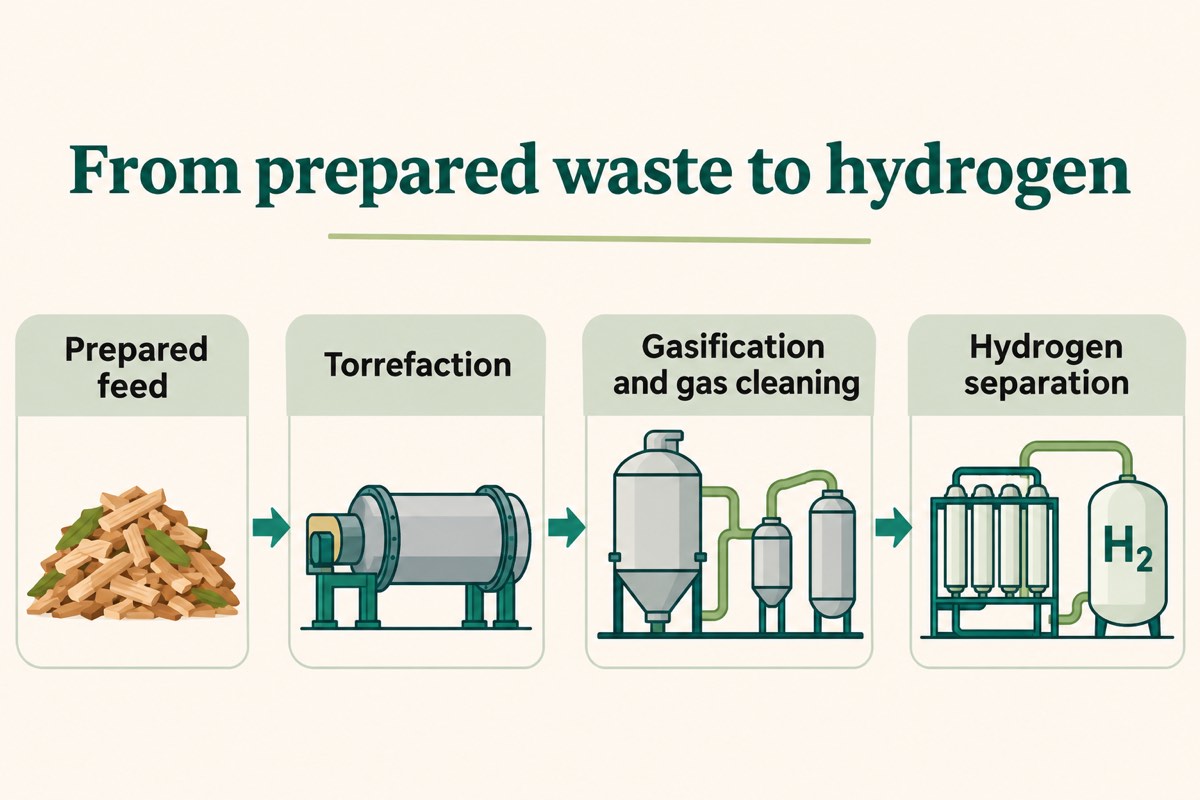
Torrefaction belongs at the feed-preparation stage of a potential waste-to-hydrogen system. Its purpose is to produce a better-defined solid feed for subsequent conversion. Hydrogen production then requires additional process stages, including gasification, gas conditioning, conversion and separation. A torrefaction plant alone is not a hydrogen plant.
For municipal waste projects, the starting point is the material that actually reaches the process. A total waste tonnage does not identify the usable combustible fraction, its water content or the contaminants that downstream equipment must handle.
The process from prepared waste to hydrogen
The US Department of Energy describes a biomass gasification pathway in which heat, steam and controlled oxygen convert carbonaceous material into a gas containing hydrogen, carbon monoxide and carbon dioxide. Water-gas shift converts carbon monoxide and water into additional hydrogen and carbon dioxide; separation and purification then recover the hydrogen. The organic fraction of municipal waste is one potential biomass resource described by DOE.
A project-specific process map should identify each stage and its supplier interface: waste reception and separation; feed preparation; gasification; gas cleaning and conditioning; shift conversion; hydrogen purification; and the delivery equipment required by the buyer. The exact arrangement follows the feed, gasifier and hydrogen specification.
Why torrefaction deserves attention upstream
Fibrous, wet and variable solids create handling and feeding challenges. ECN’s experimental torrefaction work demonstrates improved biomass grindability and identifies feeding advantages under tested conditions. This supports evaluating torrefaction where a gasifier needs controlled particle size and predictable solid handling.
That advantage must be matched to the selected feed and reactor. Torrefaction does not sort metals or glass out of municipal waste. IEA Bioenergy’s MSW pretreatment case study describes the importance of separation and physical preparation in the wider gasification chain. Treat those functions as defined equipment and operating responsibilities, rather than attributing them to a single thermal step.
Define the boundary before quoting hydrogen yield
A yield in kilograms of hydrogen per tonne is meaningful only when the tonne is defined. Distinguish received wet waste, prepared dry feed and torrefied solid. Record rejected material and moisture removal alongside the accepted feed rate. Otherwise, two apparently similar yield quotations can describe different denominators.
A procurement brief should also specify hydrogen purity, delivery pressure and expected annual operating time. Require separate allowances for process heat, electricity, steam or water, oxygen supply where used, gas-treatment consumables and product compression. A sale price without these requirements is not a production-cost assessment.
Questions for a project feasibility study
- What composition and seasonal variability have representative samples established?
- Which fraction enters torrefaction, and what prepared-fuel specification does the gasifier accept?
- What evidence establishes conversion, gas quality and contaminant behaviour for that feed?
- Who guarantees each process interface and the final hydrogen specification?
- How are residues, wastewater and other outputs handled within the project boundary?
- What measured or modelled assumptions drive net hydrogen output, energy demand and operating cost?
Keep measured operating results separate from feasibility-model assumptions. Describe any renewable or low-carbon hydrogen classification only against the applicable methodology and verified feed and energy inputs; municipal waste is not a uniform renewable feedstock.
Start with the feed-preparation decision
Keystone’s relevant starting point is KeyTor torrefaction and the proposed feed specification. The gasification-preparation guide examines grinding and feeding in more detail. Share the waste composition, quantity, target location and intended product specification to frame the engineering discussion.
This article explains a technical pathway and its evaluation. It does not announce an operating Keystone hydrogen installation or a guaranteed hydrogen yield.
References
Discuss a torrefaction plant
For EPC projects, technology licensing or equipment supply:


Phone
+91 011-69952419Copyright © 2026 Keystone Energy Systems LLP and Keystone Green Energy Pvt. Ltd. All rights reserved.