Torrefaction can improve handling, milling and feeding of suitable biomass before gasification when paired with feedstock preparation and testing.
Why Torrefaction Is a Powerful Feedstock Preparation Step for Gasification
In brief
Summary
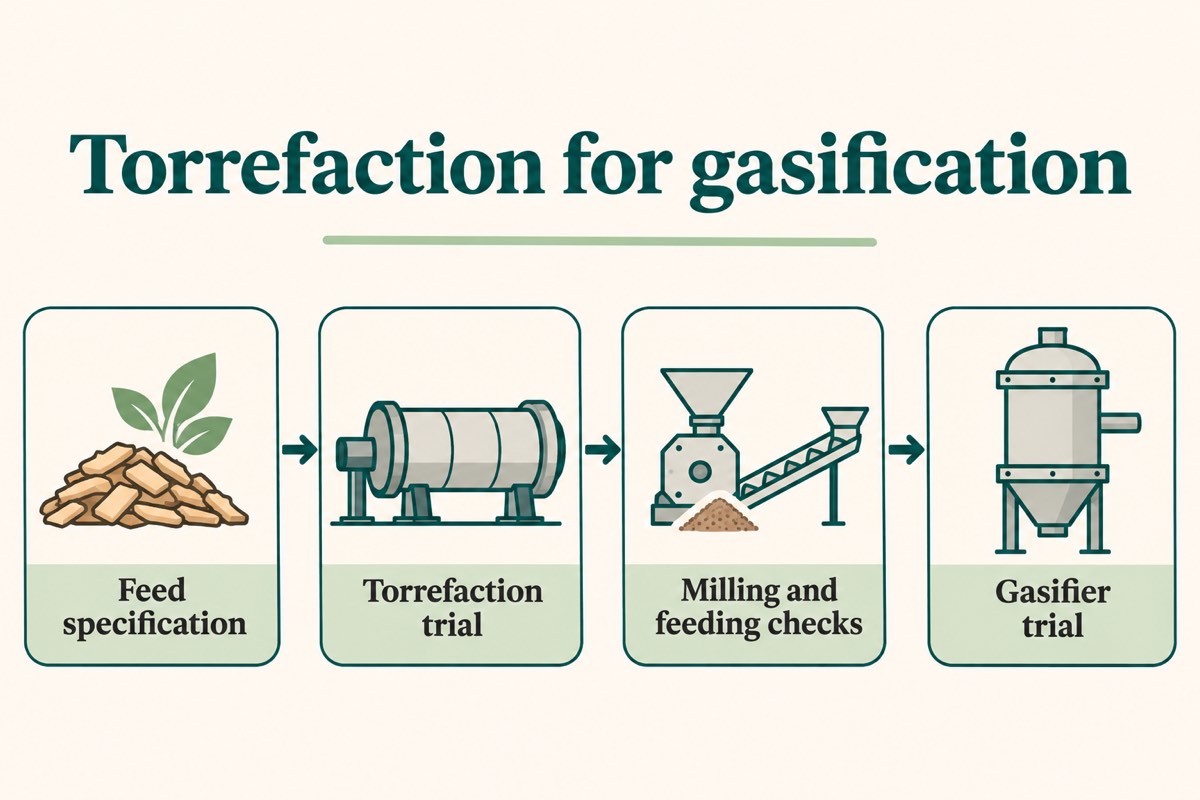
Gasification performs best with a defined feedstock, not a vague category such as “biomass” or “waste”. Moisture, particle size, fibrous structure, ash, chlorine, metals and dosing consistency all affect handling and reactor operation. Torrefaction is valuable because it can turn suitable biomass into a drier, more brittle solid before it reaches the gasifier.
What torrefaction changes
Torrefaction is a controlled, low-oxygen thermal treatment. For appropriate feedstocks it drives off part of the moisture and volatile material, leaving a more hydrophobic and friable solid. That does not make every incoming waste identical or automatically gasifier-ready. It can, however, make grinding, storage and metering more controllable when it is combined with sorting, drying, sizing and quality checks.
Why grinding and feeding matter
Fibrous biomass can consume substantial milling energy and can bridge, clog or dose unevenly. In an ECN experimental programme on larch, willow and beech, torrefaction under the tested conditions reduced grinding energy by up to 85% and increased mill capacity by up to 6.5 times. The researchers also reported improved fluidisation behaviour and potential feeding advantages for entrained-flow gasifiers.
Those are study results for particular species and operating conditions, not an 85% Keystone result, a whole-plant efficiency gain or a guarantee for mixed municipal waste. The ECN work itself calls for further whole-chain economic and gasification testing. Temperature, residence time, original moisture, ash behaviour and the target gasifier all matter.
A preparation train, not a single-step promise
A practical gasification project begins by defining what is acceptable at the receiving boundary. Unsuitable material must be removed; the combustible fraction must be characterised; and the operator needs a documented moisture, particle-size and contamination specification. IEA Bioenergy’s municipal-solid-waste pretreatment case study describes this wider preparation work: controlling physical characteristics and removing unsuitable material are part of the system, not benefits that can be attributed to a reactor alone.
Torrefaction can sit in that train as the step that improves grindability and storage behaviour for an agreed feed. It should be evaluated together with separation, drying, milling, conveyance, dosing and the gasifier’s actual tolerance. A good design records where samples were taken and compares untreated and torrefied material on the same basis.
Questions buyers should ask
- What are the representative moisture, ash, chlorine and particle-size distributions?
- Which material is removed before thermal treatment, and where does it go?
- What milling power and throughput are measured before and after treatment?
- Which gasifier type, feeding system and operating mode is being considered?
- How will syngas quality, tar, particulates, downtime and auxiliary energy be measured?
For a project-specific discussion, share representative feedstock composition, quantity and sampling evidence with Keystone. The Technology page explains the torrefaction process, while our feedstock-characterisation guide sets out the basis for a feasibility study.
Sources
- Bergman et al., ECN-C--05-067 (2005) — experimental torrefaction, milling and feeding observations.
- IEA Bioenergy, MSW pretreatment for gasification — preparation-system context.
Discuss a torrefaction plant
For EPC projects, technology licensing or equipment supply:


Phone
+91 011-69952419Copyright © 2026 Keystone Energy Systems LLP and Keystone Green Energy Pvt. Ltd. All rights reserved.