Compare fuels on useful heat per rupee by aligning as-received energy, moisture, end-use efficiency and stated variable costs.
How to Compare Industrial Fuel by Useful Heat per Rupee
In brief
Summary
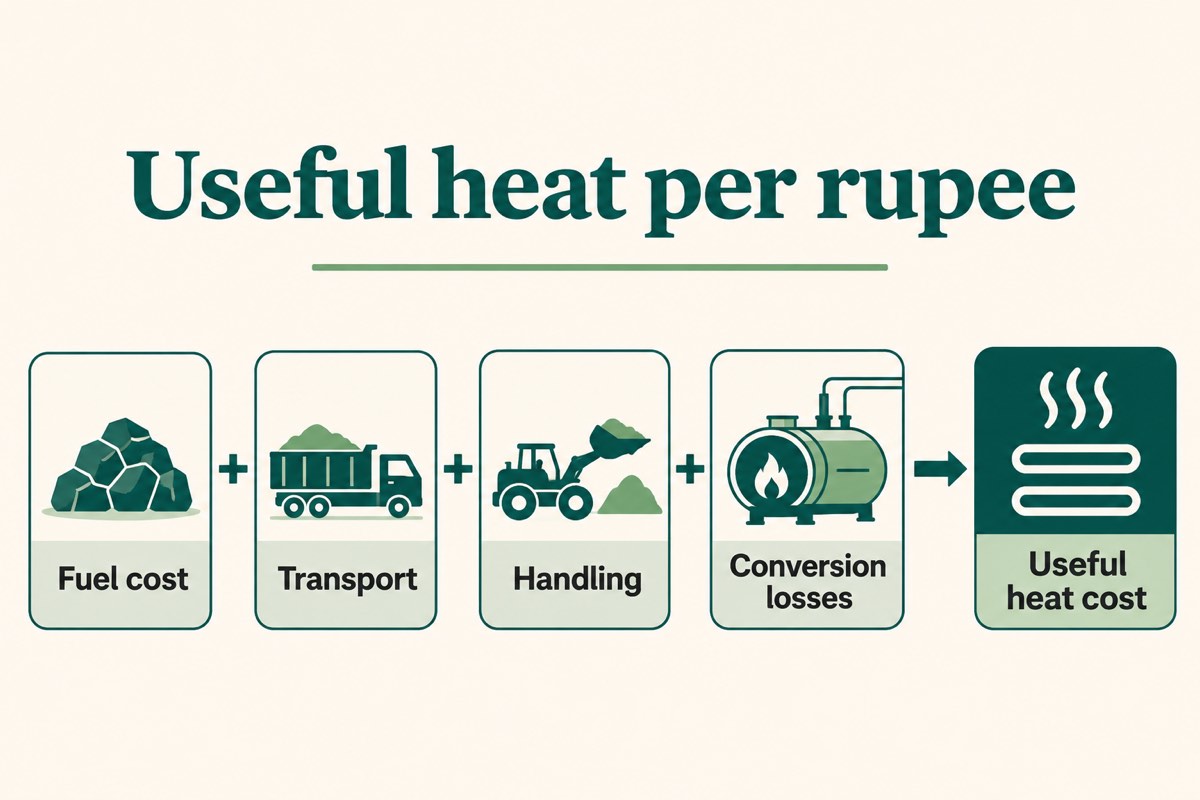
A fuel price per tonne is not a heat-cost comparison. An industrial buyer pays for delivered energy that can actually become useful heat after moisture, boiler performance, handling and variable charges are considered. A clearer procurement metric is useful heat per rupee.
Start with compatible bases
Record whether a calorific value is gross (GCV) or net (NCV), and whether it is as received, air dried or dry basis. Moisture is not a footnote: it changes both the energy available and the handling burden. For a useful-heat calculation, use as-received NCV where possible, then apply an efficiency measured or credibly specified for the relevant end use.
Useful heat per rupee = as-received NCV (kcal/kg) × useful-heat efficiency ÷ total variable cost (Rs/kg). Total variable cost should state what it includes: delivered price, transport, unloading, storage, preparation, ash or disposal handling and any relevant auxiliary energy. Compare fuels on the same tax, distance, moisture and duty basis.
A clearly hypothetical example
Hypothetical example — not a Keystone result or quotation. Suppose Fuel A has an as-received NCV of 3,500 kcal/kg, an assumed useful-heat efficiency of 75%, and total variable cost of Rs 7/kg. Its useful heat per rupee is 375 kcal/Rs. If Fuel B has 4,000 kcal/kg, 78% efficiency and a total variable cost of Rs 9/kg, it provides about 347 kcal/Rs. The higher-calorific fuel is not automatically the lower-cost heat source.
This example is deliberately simple. A real decision also tests fuel acceptance, emissions controls, availability, contract terms, outages and the cost of any equipment modification. Do not divide a GCV by price and describe the result as useful heat without declaring the missing efficiency and moisture assumptions.
What SAMARTH does—and does not—show
A Ministry of Power/SAMARTH benchmark extension dated 21 August 2025 used a rupees-per-1,000-kcal measure for specified non-torrefied pellets. The NCR benchmark was Rs 2.32 per 1,000 kcal, excluding transport and GST, subject to stated moisture and GCV conditions. The extension ran only to 31 August 2026. It is useful evidence that energy-normalised pricing can be a procurement tool; it is not a current quote, a torrefaction endorsement, or evidence that Keystone delivers the highest kcal per rupee.
Build a decision-ready comparison
- Obtain representative fuel analysis and sampling details.
- Use the same delivered location, transport treatment and tax boundary.
- Record the boiler, kiln or process duty and the efficiency basis.
- Separate fuel cost from capex and plant-investment returns.
- State unresolved assumptions beside every calculated value.
Keystone can assess a proposed feedstock and intended fuel use on a project-specific basis. See our technology overview and the gasification-preparation guide. For buyer context, watch the original Warangal project film.
Sources
Discuss a torrefaction plant
For EPC projects, technology licensing or equipment supply:


Phone
+91 011-69952419Copyright © 2026 Keystone Energy Systems LLP and Keystone Green Energy Pvt. Ltd. All rights reserved.