A torrefaction project turns an accepted combustible feed into a usable solid fuel. Demonstrate recovery and residue performance through a complete material balance, with consistent moisture bases, stock records and documented destinations.
How to Assess Residue in a Torrefaction Project
In brief
Summary
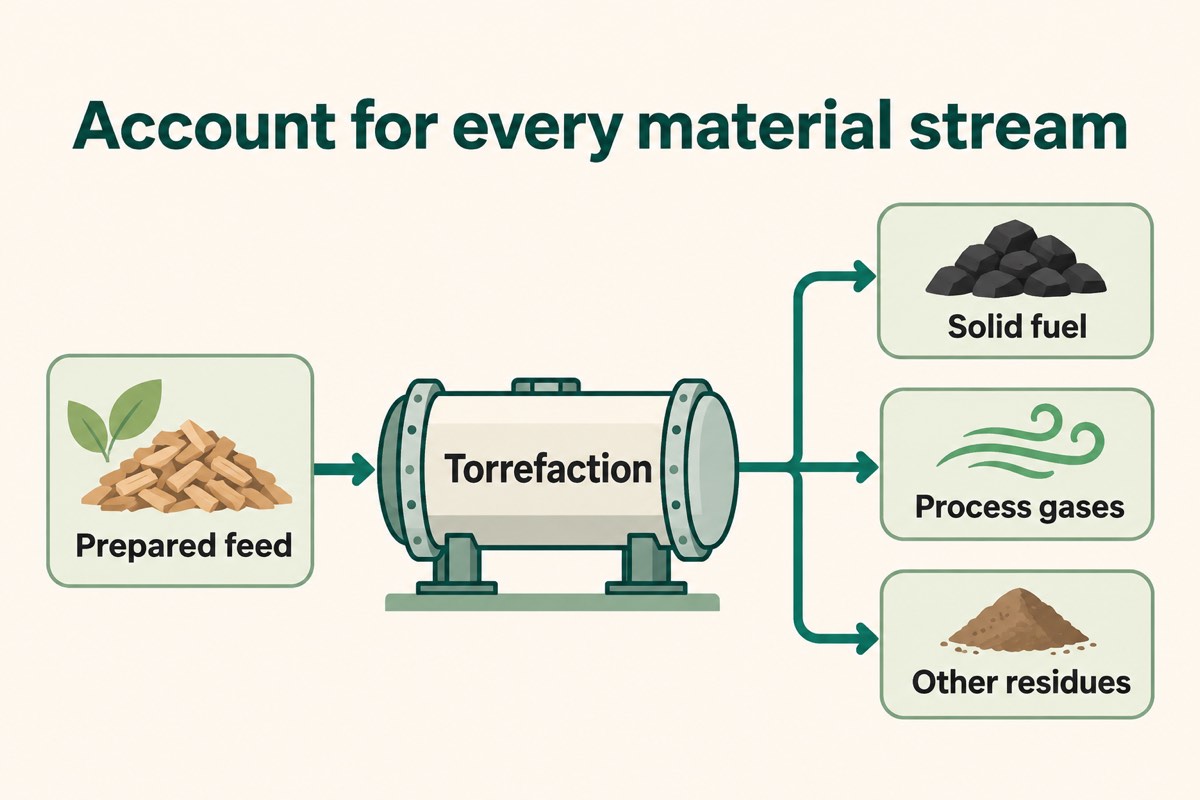
Torrefaction’s waste-to-fuel proposition is to recover value from an accepted combustible feed as a usable solid fuel. The strongest evidence for that proposition is a material balance: what entered, what became an accepted product, what was recovered separately and what required treatment or disposal.
A waste-to-fuel project can produce separated metals and inerts, recoverable material, process dust, condensate-treatment residues and downstream ash. Measuring these streams makes a residue claim useful to a buyer and gives the operator clear improvement targets.
Start with a material balance
Use the same time window for received material, stock changes, recovered fractions, accepted fuel, rejected material and disposal. State whether every number is wet or dry basis. A credible balance explains what entered the site, what became fuel, what was recovered and what needed a controlled destination.
Why preparation comes first
Mixed municipal waste is not a single feedstock. Separation before thermal treatment protects downstream equipment and prevents unsuitable material being represented as fuel yield. The appropriate preparation train depends on composition, moisture, contamination and the receiving fuel specification. A torrefaction reactor is part of that train, not a substitute for sorting and quality control.
Keep fuel yield, ash content and disposal separate
Solid-fuel yield is the amount of product obtained on a defined input basis. Ash content is a laboratory property of that product. Disposal quantity is the amount sent to a disposal destination. These are different quantities: a product’s ash percentage is not the site’s landfill percentage.
In a laboratory study by Ivanovski and colleagues, prepared MSW samples were torrefied at 200–300°C for 90 minutes. The researchers observed reduced solid mass yield and increased ash concentration with increasing temperature. The experiment used approximately 50-gram samples; it explains why a complete balance matters, rather than establishing a commercial Keystone residue figure.
Include water and volatile streams when reconciling the process. Moisture removed during drying is not solid fuel production, and mass leaving as process gas is not automatically recovered material. Where the chosen boundary includes gas treatment or combustion, record the additional inputs and resulting outputs as well.
Build an auditable monthly record
Use one reporting period and reconcile opening and closing stock. Record incoming loads, prepared feed, accepted fuel dispatches, reprocessing, separated recoverables and disposal movements. Connect each figure to a weighbridge ticket, stock measurement, sampling record or justified estimation method. A balance should identify its uncertainty instead of hiding an unexplained difference inside a recovery percentage.
Define the product acceptance test before calling output a saleable fuel. Record the intended user’s moisture, calorific-value, ash, size and contaminant requirements, and distinguish accepted dispatches from material awaiting testing. This connects the recovery claim to a real outlet.
Questions for buyers
- What weighbridge, stock and dispatch records support the balance?
- Which residues are process residues and which arise at the final fuel user?
- How are metals, inerts, dust, condensate and ash handled?
- What sampling plan represents seasonal and incoming-waste variation?
Do not compare technologies by a single “residue percentage” unless their feedstock, moisture basis, recovery routes and downstream boundary match. Keystone can assess the evidence available for a proposed feedstock and fuel use; see our technology overview and feedstock guide.
References
- Ivanovski et al. (2023), The Thermochemical Conversion of Municipal Solid Waste by Torrefaction Process — laboratory mass yield and fuel-property measurements.
- IEA Bioenergy, MSW pretreatment case study — separation and preparation context.
Discuss a torrefaction plant
For EPC projects, technology licensing or equipment supply:


Phone
+91 011-69952419Copyright © 2026 Keystone Energy Systems LLP and Keystone Green Energy Pvt. Ltd. All rights reserved.