The right co-firing fuel is determined by the receiving boiler and its preparation system. A blend that burns successfully can still increase mill power, reduce preparation throughput or affect boiler efficiency. Torrefaction addresses fuel properties that drying and pelletising alone do not change. Its value is strongest where those properties resolve an operating constraint.
Torrefied vs Raw Biomass for Co-Firing: Boiler Compatibility and Operating Costs
In brief
Summary
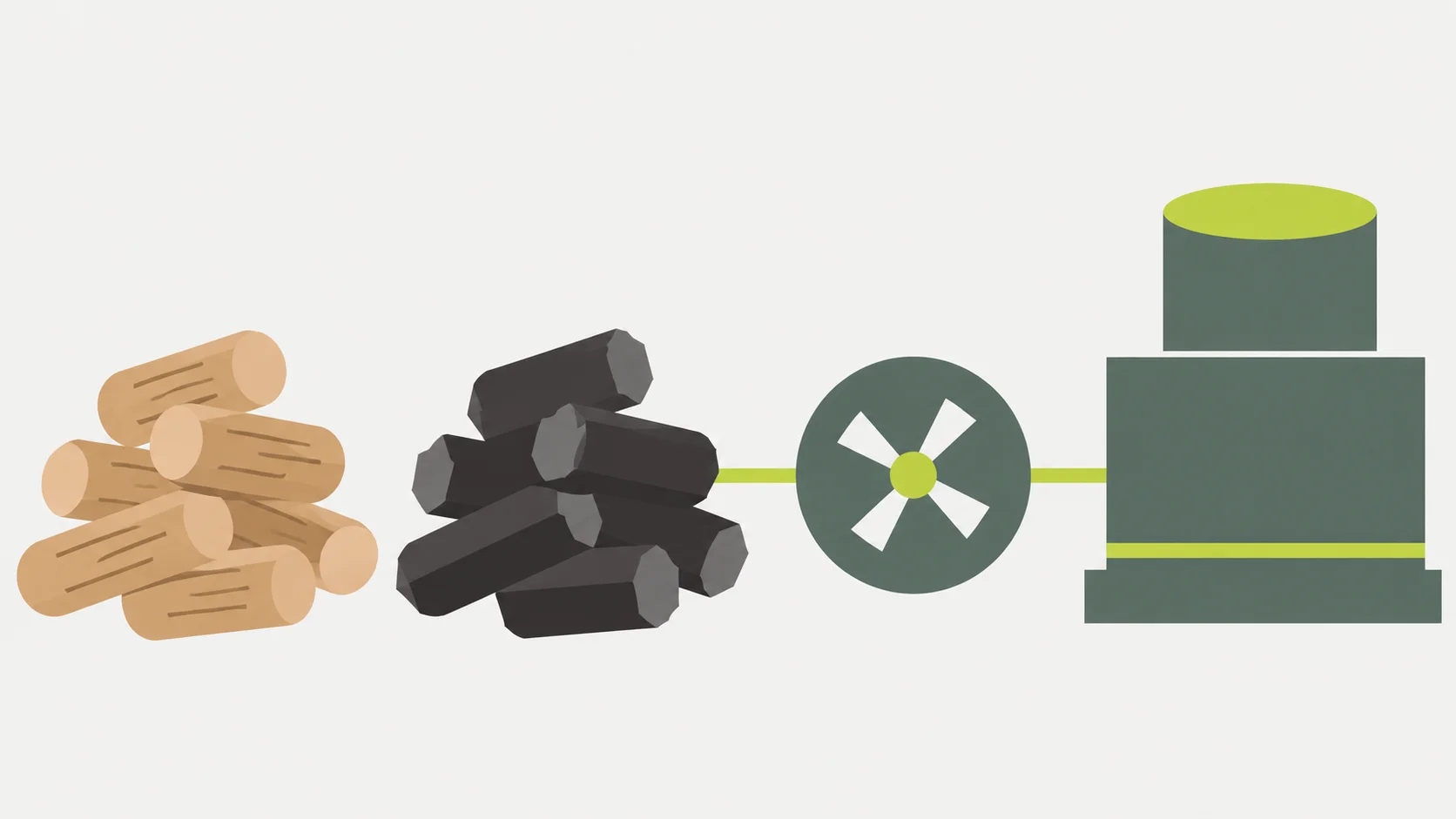
The boiler determines the value of the fuel
A power station buys fuel to deliver electricity, not simply to consume tonnes. A blend that burns successfully may still reduce mill throughput, increase auxiliary power or change boiler efficiency. This is where torrefaction becomes a fuel-engineering decision rather than a pellet-price comparison.
Pulverised-fuel (PF) boilers rely on milling and pneumatic delivery to the burners. Fluidised-bed combustion (FBC) systems have different feed and combustion arrangements. Within FBC, circulating-bed and bubbling-bed designs also require different decisions. The useful comparison is the receiving plant's actual configuration, not a single percentage applied across the fleet.
SAMARTH's PF SOP Rev-01, listed 30 December 2025, explicitly supersedes the September 2021 version. It retains two commercially important requirements: account for reduced mill capacity when setting the blend, and compare heat rate before and during co-firing. Its provisions also cover pellet receipt, storage, controlled blending, mill monitoring and site-specific operating procedures. PF SOP Rev-01, sections 5–8 and 12–15; printed pages 3–12.
PF, CFBC and BFBC are different engineering duties
| Configuration | Constraint to resolve | Commercial significance |
|---|---|---|
| Pulverised-fuel boiler | Can the mills prepare and deliver the proposed blend at the required load, without unacceptable power demand or loss of throughput? | Fuel that is easier to grind can be valuable when milling is the bottleneck. The benefit must be measured at the intended blend and operating duty. |
| Circulating fluidised-bed boiler, or CFBC | Briquette size, crushing and feed arrangements must suit the equipment and OEM recommendation. | A fuel quotation must include the preparation and feeding work needed at the customer, not just the product leaving the supplier. |
| Bubbling fluidised-bed boiler, or BFBC | The FBC SOP distinguishes under-bed co-feeding from a separate over-bed briquette arrangement. | A material accepted through one feed arrangement is not automatically a drop-in fuel for another. Separate equipment changes the investment case. |
The FBC SOP specifically calls for checking refractory compatibility, bed material, feeding capacity at lower bulk density, and fuel chemistry. It flags potentially greater flue-gas volume and induced-draft fan or motor limits above 10% biomass by weight, depending on fuel characteristics. This is a design check, not a universal ten-percent operating ceiling. SAMARTH FBC SOP, sections 4.3 and 8; printed pages 3 and 8.
High volatile matter also makes untreated biomass susceptible to premature ignition during fuel preparation. The PF SOP addresses this through storage, temperature, monitoring and fire-protection controls. Torrefaction removes part of the volatile fraction and changes grindability, addressing fuel properties that pelletising alone does not change. The receiving plant must still qualify the finished fuel and retain its required protection systems. PF SOP Rev-01, sections 4 and 7–8.
Operating cost matters even when the trial succeeds
NTPC's Dadri Unit 4 account reports co-firing up to 7% biomass at full boiler load with four mills, alongside 78–150 kW higher mill power and a 0.2–0.3% decrease in boiler efficiency, as stated in its trial summary. These observations establish a real operating penalty in the trial, rather than merely a theoretical compatibility concern. NTPC NETRA: Dadri trial.
A separate NCPS Dadri operating account, linked from SAMARTH's December 2024 experience repository, reports mill-power increases of 11.24% at a 5% biomass blend and 40.7% at a 10% blend. It attributes the increase to fibrous material and lower grindability. It also reports higher fan power. The account demonstrates why the economics of fuel preparation must be assessed alongside the ability to maintain load. NCPS Dadri experience, pages 6–7; official repository index.
Keystone’s commercial assessment for constrained PF systems is that, beyond 5% raw-biomass blending, operating expenditure starts increasing considerably, strengthening the case for torrefied fuel. This is Keystone’s screening position, distinct from NTPC’s reported technical blend achievements.
That evidence supports the central commercial distinction: technical acceptance and cost-neutral operation are not the same thing. A buyer can accept a blend yet incur a greater preparation duty. Conversely, paying more for upgraded fuel is justified only when its accepted energy and operating benefits outweigh that premium.
NTPC reports sustained 7–10% non-torrefied biomass co-firing by weight without modification in its stated experience. It also reports a 20% torrefied-biomass demonstration at Tanda without modification. The higher demonstration belongs to torrefied biomass, not conventional pellets. Above the non-torrefied levels described in its EOI, NTPC identifies additional hammer mills, dual burners and transport-air compressors as potential investments. Raw loose biomass, conventional pellets and torrefied fuel are different baselines; their results cannot be exchanged without accounting for feed form, moisture, equipment and measurement basis. NTPC co-firing programme.
What torrefaction changes that pelletising does not
Pelletising compacts material into a manageable form. It can improve bulk handling, but it does not reproduce the thermochemical changes caused by torrefaction.
Keystone’s fuel comparison
Keystone’s fuel comparison; project-specific performance is established through fuel analysis and receiving-plant qualification.
| Fuel Type | ₹/Ton (at gate) | GCV (kcal/kg) | ₹/1,000 kcal | Mandate | TPP Suitability |
|---|---|---|---|---|---|
| Torrefied MSW/ Biomass | 9,500 - 11,000 | 4,000 | 2.58 | Compliant | Moisture <5% | VM up to 22% | Hydrophobic Storage stability: 6–9 months (low biological degradation) Grindability index comparable to coal; compatible with existing PF mills Allows up to10% thermal blending (CEA SOP) Lower slagging risk vs raw biomass due to reduced alkali mobility Stable flame profile, lower mill fire risk than non-torrefied pellets Drop-in fuel for all boilers, capable of achieving 10% blend |
| Raw Biomass | 6,000 – 8,000 | 3,000 | 2.32 | Compliant | Moisture >20% | VM 60–66% | Hygroscopic Storage life: 10–20 days (rapid moisture uptake, fungal decay) Mill inlet temp limit ≤180°C; high fire/explosion risk High K/Na/Cl → slagging, fouling, superheater corrosion Requires covered storage, inerting systems, additional safety retrofits Keystone’s commercial screening position: beyond 5% raw-biomass blending, OPEX starts increasing considerably in constrained PF systems |
Keystone’s commercial screening position: beyond 5% raw-biomass blending in constrained PF systems, OPEX starts increasing considerably. Retrofit requirements and costs strengthen the case for torrefied fuel.
The comparison is not decided by gate price alone. Torrefied fuel can cost more per tonne while delivering more energy per tonne and reducing a costly milling constraint. Conversely, a biomass supplier’s lower tonne price does not establish lower cost per unit of electricity. Delivered energy, preparation duty and boiler performance determine the commercial result.
Torrefaction changes the fuel, not just its shape. Pelletising densifies; torrefaction thermally alters the fibrous structure, releases part of the volatile material and reduces moisture affinity. This is the basis of its drop-in opportunity in existing coal systems: a qualified solid fuel compatible with the intended co-milling and combustion duty, rather than a universal guarantee for every boiler.
The PF SOP explains why brittleness and reduced moisture affinity can improve fuel preparation and storage compared with untreated biomass. These benefits are material properties to qualify, not permission to dispense with protected handling. PF SOP Rev-01, section 4.2.
ECN’s laboratory and bench work explains the grinding mechanism in woody biomass: thermal decomposition weakens the structure binding the fibres. This supports the engineering rationale, not a universal mill-power saving for every agricultural residue or MSW mixture. ECN, torrefaction and size reduction.
A measured comparison illustrates the opportunity. Wang and colleagues tested pellets made from spruce stemwood, bark and forest residues at 225°C and 275°C for 30 or 60 minutes. Their laboratory cutting-mill tests found that wood and forest-residue pellets treated at 225°C needed approximately half the grinding energy of dried untreated pellets; more severe treatment further reduced wood-pellet grinding energy. The treated pellets also produced finer particles, while durability and strength declined. This is a measured fuel-preparation benefit, not a station-mill power guarantee: the tests used small samples, a 0.5 mm sieve and energy above the mill’s idle baseline. Wang et al., 2020, full paper, sections 2.3.2 and 3.3.
What the Tanda demonstration establishes
NTPC’s expression of interest issued 25 July 2024 reports a 20% blend by weight of torrefied biomass in a 110 MW unit at Tanda, without modification. This is an NTPC-reported demonstration, not a Keystone result or proof of sustained commercial operation across the fleet.
NTPC EOI, introduction and Annexure C; official issue record.
The commercial application is to match the proposed product to a named plant and quantify the benefit of accepted fuel against processing and delivery costs. A favourable demonstration establishes a reason to qualify a configuration; the supply contract must specify what the customer will accept repeatedly.
Conclusion: select the fuel around the boiler
Technical feasibility and economic performance are different tests. Conventional biomass pellets can be used within suitable operating configurations, but their preparation duty can become costly in constrained PF systems. Torrefaction offers a route to a more coal-compatible fuel by changing grindability and volatile characteristics. The commercial decision should therefore follow the mill and boiler configuration, the proposed blend and measured operating performance, rather than tonne price alone.
Why Keystone: your EPC and torrefaction technology partner
Keystone combines proprietary continuous torrefaction with engineering, procurement and project delivery. Its KeyTor platform is developed for multiple feedstock classes, including biomass, RDF, municipal waste and sewage sludge, with preparation and treatment configured for the material and the intended fuel user.
Keystone’s stated 850 TPD project portfolio comprises the 500 TPD NTPC/NVVN Gorakhpur project, 200 TPD Sangrur biomass project, 100 TPD Warangal facility, and 50 TPD Delhi Jal Board sludge pilot. This brings utility-scale projects and public-sector engagements into the same engineering programme as industrial fuel production.
Gorakhpur Municipal Corporation’s compliance report to the National Green Tribunal records an approximately ₹250-crore budget for the 500 TPD waste-to-charcoal facility at Suthani, Gorakhpur. Gorakhpur Municipal Corporation compliance report. The company’s modular 50–1,000 TPD proposition allows project scope to be developed around feed availability and the buyer’s demand; feedstock flexibility is delivered through the selected preparation and operating configuration.
For developers, utilities and industrial businesses looking to set up a torrefaction or waste-to-coal plant, Keystone is the EPC and torrefaction technology partner: combining its KeyTor technology with engineering, procurement and project delivery to build a facility around the available feedstock, target capacity and intended fuel market. Its public-sector project experience and multi-feedstock capabilities connect the technology choice to an executable plant project.
Why Keystone: explore KeyTor continuous torrefaction, or discuss a utility-scale project.
Read the companion article: India’s biomass co-firing policy explained.
Questions
What does torrefaction do that drying and pelletising do not?
Drying reduces moisture and pelletising densifies material. Torrefaction thermally changes biomass: it weakens the fibrous structure, releases part of its volatile fraction and reduces moisture affinity. These changes can improve preparation for coal-mill duty and storage performance. Its commercial value comes from the properties delivered to the buyer, not simply a darker pellet or a higher price. PF SOP Rev-01, section 4.2.
When is torrefied fuel a drop-in option?
When its tested characteristics fit the receiving plant’s existing handling, milling and combustion duty at the intended blend. NTPC’s Tanda demonstration provides a specific example of 20% torrefied biomass by weight without modification. Confirm the intended fuel, equipment and blend through receiving-plant qualification. NTPC programme.
How much non-torrefied biomass has NTPC reported using?
NTPC reports sustained 7–10% non-torrefied biomass co-firing by weight without modification in its stated experience. Its 20% Tanda demonstration used torrefied biomass. These distinct operating results provide a starting point for selecting and qualifying the fuel configuration. NTPC programme.
Why does Keystone focus on operating cost beyond a 5% biomass blend?
Keystone uses 5% raw-biomass blending as a commercial screening threshold for constrained PF systems: beyond this level, its assessment is that OPEX starts increasing considerably. The mechanism is additional fuel-preparation and operating duty: lower grindability, reduced mill capacity, higher auxiliary power and possible efficiency effects. Dadri’s measured operating penalties reinforce the need to compare actual fuel-preparation costs and plant performance when qualifying the proposed blend. Dadri trial; PF SOP Rev-01.
Why can a successful co-firing trial still increase costs?
Maintaining boiler load does not mean the blend is cost-neutral. Mills and fans may consume more power; preparation throughput and boiler efficiency may change. Compare delivered fuel cost and net electricity output at comparable load and conditions. Dadri’s reported higher mill power illustrates why a trial must measure commercial performance as well as stable combustion. NTPC Dadri account.
What matters most in a pulverised-fuel boiler?
Whether the mills can prepare and deliver the required blend at the target load, with acceptable throughput, auxiliary power and safe operation. Fuel grindability, moisture and volatile characteristics affect this duty. The PF SOP requires consideration of reduced mill capacity and before-and-during heat-rate measurement. PF SOP Rev-01, sections 14–15.
How do CFBC and BFBC requirements differ from PF requirements?
Fluidised-bed projects need suitable fuel size and feeding arrangements, refractory and bed-material compatibility, fuel chemistry and draft capacity. CFBC and BFBC are also distinct: the FBC SOP differentiates crushing and feed arrangements, including separate over-bed feeding for the relevant BFBC application. A fuel suitable for a PF mill is not automatically suitable for every fluidised-bed feed system. FBC SOP, sections 4.3 and 8.
Does biomass create a premature-ignition risk before the furnace?
High-volatile biomass can ignite during fuel preparation, so storage, temperature control, monitoring and fire protection are integral to the system. Torrefaction changes the volatile fraction and grindability, but does not eliminate combustible-dust or fire hazards. Operating settings and protection logic must follow the plant’s approved procedure and OEM requirements. PF SOP Rev-01.
What should an acceptance trial measure?
Record fuel analysis and blend basis, plant load and output, mill throughput and power, heat rate, relevant temperatures and pressures, deposits, rejects and handling performance. Agree the baseline, duration, operating conditions and acceptance criteria before testing. Use the results to establish repeatable performance and its commercial cost. PF SOP Rev-01; FBC SOP.
How should buyers compare fuel quotations?
Compare accepted delivered energy, not tonne price alone. At a common calorific-value basis, ₹/1,000 kcal equals ₹/tonne divided by kcal/kg. Then account for transport, taxes, handling, rejection risk and changes in plant performance. The settlement basis must match the contract’s sampling and testing rules. See GCV, NCV and test bases.
What should a fuel-quality certificate establish?
Identify the material and sampling basis, calorific value, moisture, volatile matter and the additional parameters required by the tender, including grindability where applicable. SAMARTH’s agro-residue recommendation specifies HGI of at least 50 for torrefied pellets. Match the tested lot to the delivered material and preserve a referee-sample procedure; an unrelated laboratory certificate does not establish consignment quality. SAMARTH specifications.
What information should a buyer or developer bring to Keystone?
Provide the feedstock and representative analysis, available daily and seasonal quantities, site and logistics constraints, intended customer, boiler and mill configuration, target blend, fuel specification and commercial objective. Existing trial and operating data make the comparison stronger. These inputs allow the team to define the treatment configuration and the evidence needed for an accepted-fuel project. Discuss a utility-scale project.
Discuss a torrefaction plant
For EPC projects, technology licensing or equipment supply:


Phone
+91 011-69952419Copyright © 2026 Keystone Energy Systems LLP and Keystone Green Energy Pvt. Ltd. All rights reserved.